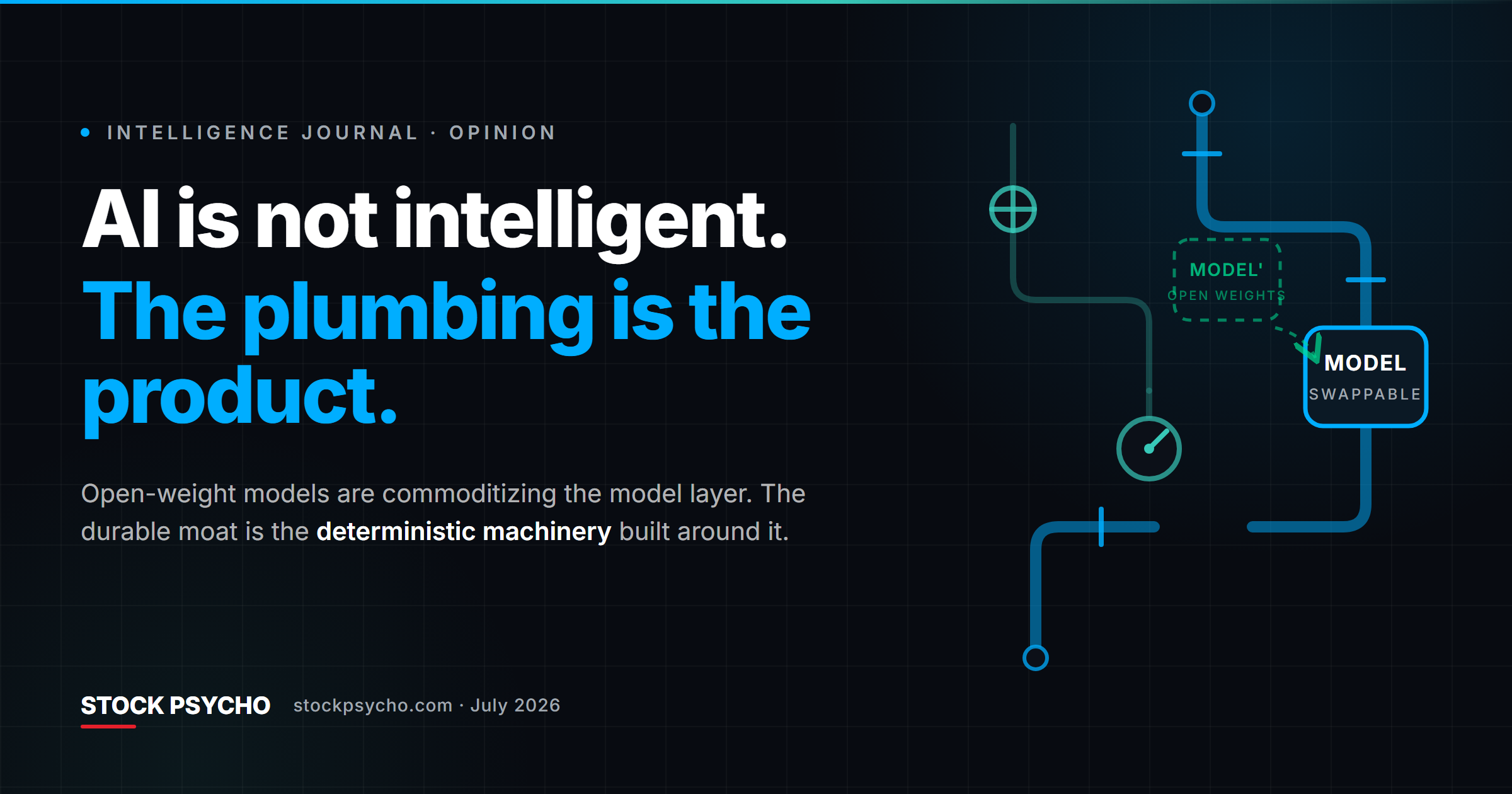
Chinese open-weight models are destroying the model moat—but they are not solving the reliability problem at the center of generative AI.
The AI industry keeps asking the wrong question.
Which model is smartest? Which country is winning? Which laboratory has the best benchmark score? Is the future proprietary or open source?
For businesses deploying these systems, none of those questions is the most important one.
The real question is much less glamorous:
How do you turn a probabilistic language generator into a system that can be trusted to perform a defined job repeatedly, without inventing facts, corrupting data or making an expensive decision based on linguistic confidence?
That is where the long-term value of large language models will be determined.
LLMs are likely to survive. The mythology surrounding them may not.
The Chinese models are changing the economics
China's rapid progress in large language models is real. DeepSeek disrupted assumptions about how much money and hardware were required to create a competitive model. Alibaba's Qwen family, Zhipu's GLM models, MiniMax and Moonshot AI's Kimi models have continued applying pressure.
On July 16, 2026, Moonshot released Kimi K3, the latest model in a progression that included Kimi K2, K2.5 and K2.6. The release was positioned around coding, long-horizon reasoning and agentic work. Reuters described K3 as a massive open-weight model competing directly with leading American systems.
This matters, but perhaps not for the reason markets assume.
The Chinese model wave is not proving that machines have achieved intelligence. It is demonstrating that the underlying model layer is becoming a commodity faster than many American AI companies expected.
A capable model can now emerge from another laboratory, another country or another open-weight community within months. Customers can route tasks among models, self-host certain models or replace one provider when pricing, policies or performance change.
That is bad news for any company whose only moat is access to a supposedly magical model.
It is very good news for companies building real systems.
Open weights are not the same as open source
Much of the discussion around Chinese AI models casually treats "open weight" and "open source" as interchangeable terms. They are not.
Open weights generally mean that the trained numerical parameters can be downloaded and used to run or modify the model. The Open Source Initiative's formal definition goes much further. It requires sufficiently detailed training-data information, the code used to train and run the system, and the parameters necessary for a skilled party to study, modify and substantially reproduce it.
Receiving the weights is more like receiving an engine than receiving a functioning vehicle.
The engine may be extraordinarily powerful. You still need the transmission, steering, brakes, sensors, operating controls, maintenance procedures and a competent driver.
Running an open-weight model properly can require expertise in GPU infrastructure, inference engines, quantization, memory management, tokenizers, chat templates, context handling, model routing, structured output, security, monitoring and evaluation. Even Hugging Face's own openness guidance notes that modeling code must accompany the weights for the model to run.
A model can technically run while still being incorrectly configured.
A faulty prompt template can degrade its behavior. Aggressive quantization can alter output quality. Incorrect sampling settings can destabilize reasoning models. Poor context management can bury critical facts. Missing permission controls can allow a model-connected agent to take actions that were never intended.
The download may be free. The competence required to operate it is not.
That creates an important misconception for executives: open weights do not automatically create control. They transfer responsibility.
With a commercial API, some operational complexity remains with the provider. With an open-weight deployment, the company running the model becomes responsible for its infrastructure, security, behavior, monitoring and failures.
For a sophisticated organization, that can be an excellent trade. For an inexperienced organization, it can be a spectacular way to create a system nobody fully understands.
The benefits attributed to open weights actually come from architecture
Businesses often say they want open weights because they want control, transparency, reproducibility, privacy and freedom from vendor dependence.
Those are reasonable goals.
But weights alone provide surprisingly few of them.
Most of the practical benefits executives associate with open weights can instead be created through deterministic plumbing around interchangeable models.
A serious AI system should determine which data the model may see, which sources outrank others, which tools it may call, which fields it must return, which calculations happen outside the model, which claims require citations, which outputs must be independently verified and when the system must abstain or escalate to a human.
That surrounding architecture can be deterministic even when one component inside it is probabilistic.
For example, an LLM may extract an earnings-guidance statement from a document. But software—not the LLM—should confirm the reporting period, validate the numerical format, compare the value with the previous filing, record the source passage and prevent publication when required fields are missing.
The model handles linguistic ambiguity.
The system handles truth conditions.
This distinction is the future of commercially viable AI.
The goal should not be to find one model that never fails. Such a model does not exist. The goal is to build an architecture in which any individual model failure is detected, constrained or rendered economically harmless.
A well-designed system can also swap among proprietary and open-weight models. One model may be strongest at code, another at document extraction and another at cheap classification. The intelligence—or what the market calls intelligence—becomes a replaceable component.
The enduring asset is the system that decides what each model is allowed to do.
What the models are actually replacing
The displacement is not happening where the headlines look for it. It is happening in the middle of the global labor market, in the layer that sold hours.
India's IT services sector was built on a single proposition: the same software work, produced by capable engineers, at a substantial discount to Western rates. That proposition is now being priced out of existence by tools that write, test and revise code at a marginal cost approaching zero.
The numbers describe a structural change rather than a hiring cycle. Tata Consultancy Services reported net headcount reductions exceeding 23,000 in the fiscal year that ended March 2026. At the company's annual general meeting in June 2026, chairman N. Chandrasekaran described a future in which the firm operates roughly as many AI agents as human employees. Naukri's JobSpeak data for June 2026 showed AI-related hiring inside India's IT sector up 16% year over year while overall IT recruitment fell 3%.
The mechanism is not mysterious. Traditional outsourcing priced work as time and materials: a rate multiplied by hours multiplied by headcount. Revenue and headcount were welded together. When AI compresses a six-month project into three months, utilization collapses unless the bench shrinks with it. Firms respond with hiring freezes at the entry level, voluntary separations and layoffs, and a migration toward outcome-based pricing.
Western buyers are noticing the same arithmetic from the other side. A small team of senior engineers running AI-native workflows can now match the throughput of a much larger offshore team, without the coordination tax of a twelve-hour time zone gap. The cost-per-feature math has quietly inverted even where the hourly rate has not.
This is the labor-market version of the same story the Chinese models are telling in the model layer.
Anything priced as raw generation capacity is being commoditized. Anything priced as judgment, governance and integration is not.
Notice what survives inside those outsourcing firms. The work that retains margin is the review layer: the human who catches the edge cases the model handled confidently and incorrectly, the person who owns the integration, the team that can be held accountable when the output is wrong. The delivery model that is winning routes the routine volume through the model and reserves human attention for the fraction of cases where being wrong is expensive.
That is the plumbing argument, expressed as a payroll.
The flood: what happens when the barrier to shipping software disappears
The cost collapse did not only displace professionals. It admitted an enormous number of people who had never been required to learn architecture.
This is the part of the AI story that gets celebrated and then quietly cleaned up.
Building software now requires almost no ability to read software. A quarter of the Y Combinator Winter 2025 cohort reported codebases that were 95% or more AI-generated. By early 2026, more than a third of enterprise development teams were generating substantial code blocks from natural-language prompts. Hobbyists, marketers, analysts and founders with no engineering background are shipping production applications that take payments, store personal data and make decisions.
Most of them are shipping the same failure.
Veracode tested more than 100 language models across 80 coding tasks in Java, Python, C# and JavaScript. Forty-five percent of generated samples failed basic security testing. Eighty-six percent failed to defend against cross-site scripting. Eighty-eight percent were vulnerable to log injection. These are not exotic attacks. They are OWASP Top 10 staples.
The important part is the trajectory. Veracode's March 2026 update found the security pass rate unchanged at roughly 55%, flat across the entire testing period, while coding capability benchmarks over the same window improved steadily.
Read that again, because it is the whole thesis in one data point.
The models got better at writing code. They did not get better at writing safe code. Capability and reliability are different problems, and only one of them is being solved by scale.
The downstream evidence has arrived on schedule. Georgia Tech's Vibe Security Radar tracked CVEs formally attributable to AI coding tools rising from six in January 2026 to fifteen in February to thirty-five in March. GitGuardian documented 28.65 million new hardcoded secrets in public GitHub commits during 2025, a 34% year-over-year increase and the largest single-year jump on record, with AI-assisted commits leaking credentials at roughly twice the baseline rate. One audit of fifty applications built on popular AI builder platforms found that 88% had database row-level security entirely switched off. Not misconfigured. Off. The database would return any record to any query.
By mid-2026, an estimated 8,000 startups that had built production applications on AI coding tools required partial rebuilds or rescue engineering, at costs ranging from $50,000 to $500,000. "Rescue engineering" is now a service category. It did not exist three years ago.
The debt has a distinctive shape. Conventional technical debt is a shortcut you took deliberately and can therefore reverse. This debt is different: the code works, the person who shipped it cannot explain why it works, and the first time they read it carefully is during an incident.
Now add the dependency problem, which is the one almost nobody prices.
A product built as a thin wrapper on a closed-weight model does not control the component its behavior depends on. The provider can update the model, change its refusal behavior, deprecate the version, reprice the tokens or alter the sampling defaults. Prompt engineering is not a contract. Behavior tuned against one checkpoint is not guaranteed against the next.
June 2026 supplied the extreme version of this risk. Anthropic's most capable models were pulled from every customer worldwide, with no notice, because the U.S. government issued an export control directive the company had no ability to comply with selectively. Access was restored nineteen days later after the Commerce Department lifted the controls. Teams with a routing layer moved their traffic to another model the same afternoon. Teams that had wired one model directly into production were down by executive order.
Open weights do not fully solve this either. You gain the right to keep running a specific checkpoint. You inherit the obligation to operate it.
The point is not that non-engineers should stop building. Some of the most useful systems being built right now are built by domain experts who finally do not need to hire a translator. The point is narrower and harder:
The scarce thing was never the code. It was the architecture that decides what the code is allowed to do.
A person who understands their domain deeply and builds deliberate structure around a model will outperform a credentialed engineer who does not understand the domain. A person who understands neither, but can generate working code on demand, is now capable of building something that functions perfectly until the day it does not.
My unpopular opinion: "artificial intelligence" does not exist
I do not believe current LLMs are intelligent in the way the term is sold to the public.
They are extraordinarily powerful language and pattern engines. That is not an insult. Databases, compilers, search engines and statistical models are also extraordinarily powerful. We do not need to pretend they are conscious beings to recognize their value.
An LLM generates responses by estimating plausible continuations based on patterns learned from enormous amounts of data. NIST describes one of the central resulting risks as "confabulation": confidently producing false or misleading content because the system is generating outputs that approximate patterns in its training distribution rather than verifying reality.
The word hallucination almost gives the system too much credit. Hallucination implies a mind misperceiving reality.
The model is not misperceiving reality. It does not have access to reality unless we construct a system that supplies reality to it.
It has no inherent commitment to truth. It has no lived consequences. It does not become embarrassed when it lies, afraid when it is wrong or cautious because a previous mistake caused harm.
My rescue animals demonstrate more recognizable intelligence than an LLM. They have persistent preferences, embodied memories, independent goals, social relationships, environmental awareness and a model of physical cause and effect developed through lived experience.
An LLM can be prompted to defend one conclusion and then prompted to argue the opposite. Its apparent beliefs can be rewritten through system instructions, context, fine-tuning or a cleverly phrased user request.
That is not a mind changing its opinion.
It is a system responding to altered inputs.
The fact that we can compel it to assume almost any persona, ideology or objective is not proof of intelligence. It is evidence of programmability.
LLMs cannot be responsibly deployed without guardrails
"Guardrails" are often discussed as though they are corporate censorship layers placed on top of an otherwise complete intelligence.
That framing is backwards.
Guardrails are the architecture that turns an unstable generator into a usable product.
They include far more than refusing dangerous questions. Guardrails include source restrictions, retrieval systems, access permissions, calculation engines, schema validation, factual checks, confidence thresholds, model comparisons, audit logs, human review and rules governing whether the model can take an external action.
Without these controls, an LLM is not a business system. It is an improviser with database access.
NIST's generative-AI risk framework identifies confabulation alongside information-security, privacy, bias, human-overreliance and other risks that must be addressed throughout a system's design and operation.
The mistake is treating these risks as bugs that will eventually disappear when the models become sufficiently large.
Confabulation is not simply a temporary defect caused by insufficient scale. It follows from using probabilistic generation to answer questions requiring verified factual accuracy.
A more fluent model can be more dangerous when wrong because its error is better written.
Google's German court loss is a warning to the entire industry
The legal system is beginning to recognize the difference between retrieving information and generating a new statement.
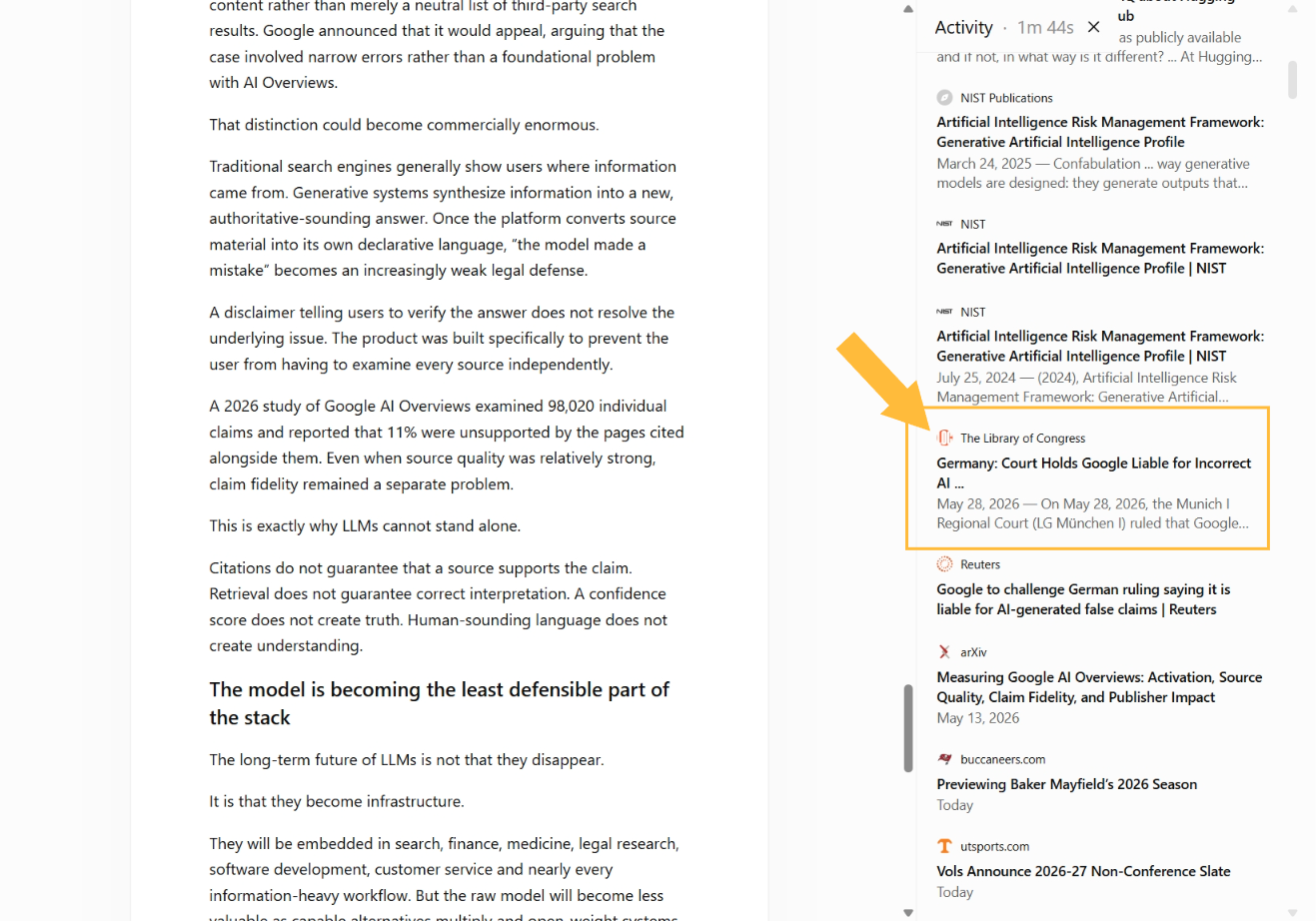
On May 28, 2026, the Munich Regional Court held Google directly responsible for false claims presented through its AI Overviews feature. Two publishers alleged that Google's generated summaries had incorrectly associated them with scams and dubious business practices.
The court treated the AI-generated summary as Google's own content rather than merely a neutral list of third-party search results. Google announced that it would appeal, arguing that the case involved narrow errors rather than a foundational problem with AI Overviews.
That distinction could become commercially enormous.
Traditional search engines generally show users where information came from. Generative systems synthesize information into a new, authoritative-sounding answer. Once the platform converts source material into its own declarative language, "the model made a mistake" becomes an increasingly weak legal defense.
A disclaimer telling users to verify the answer does not resolve the underlying issue. The product was built specifically to prevent the user from having to examine every source independently.
A 2026 study of Google AI Overviews examined 98,020 individual claims and reported that 11% were unsupported by the pages cited alongside them. Even when source quality was relatively strong, claim fidelity remained a separate problem.
This is exactly why LLMs cannot stand alone.
Citations do not guarantee that a source supports the claim. Retrieval does not guarantee correct interpretation. A confidence score does not create truth. Human-sounding language does not create understanding.
The other legal front: what went into the model
Munich is a fight about outputs. There is a second fight, considerably further along, about inputs.
The industry's foundational models were trained on an enormous quantity of material that nobody paid for. Some of it was public. Some of it was licensed. A meaningful portion was neither, and the bill is now being presented.
On July 20, 2026, a federal judge granted final approval to a $1.5 billion settlement in Bartz v. Anthropic, the largest known copyright recovery in U.S. history. Authors alleged the company had downloaded hundreds of thousands of books from shadow libraries including Library Genesis and Pirate Library Mirror in order to train Claude. The settlement pays rights holders roughly $3,000 per work across more than 482,000 books. Approximately 91% of eligible works were claimed, against a typical class-action claim rate closer to 10%. Plaintiffs' counsel was awarded roughly $122 million.
The path there is instructive. In June 2025, Judge William Alsup ruled that training on lawfully acquired books was fair use, but that acquiring them from pirate repositories was not. Once the class was certified across nearly half a million works, statutory damages of up to $150,000 per work put theoretical exposure north of $70 billion. The parties settled before trial. Anthropic admitted no liability and continues to emphasize the fair-use half of the ruling.
Two things follow from that split decision, and the industry has been loudly celebrating one while quietly absorbing the other.
Training is largely protected. Acquisition is not.
The distinction has teeth beyond books. In January 2026, Universal Music Group, Concord and ABKCO filed suit seeking roughly $3 billion, alleging Anthropic obtained more than 20,000 compositions, lyrics and sheet music files through torrenting, and naming CEO Dario Amodei and co-founder Benjamin Mann as individual defendants. The court denied a motion to stay that case in April 2026.
The most structurally significant case may be the smallest one.
Reddit sued Anthropic in June 2025 in California state court, alleging unauthorized scraping of user content, more than 100,000 unauthorized server accesses, and continued collection after the company had indicated it would stop. Reddit did not plead copyright, because Reddit does not own its users' posts. It pleaded breach of contract, unjust enrichment, tortious interference and unfair competition.
Anthropic moved the case to federal court, arguing this was a copyright claim wearing a costume. In March 2026, Judge Trina Thompson sent it back to state court, concluding that none of Reddit's causes of action asserted rights equivalent to those protected by the Copyright Act.
That remand is the part operators should read twice.
A fair-use finding protects you from copyright claims. It does not protect you from a contract you agreed to and then broke.
Terms of service, robots directives, rate limits and access agreements are separate legal instruments. They do not require the plaintiff to own a copyright. They require only that you promised something and did otherwise. Every platform that has watched its content become somebody else's training corpus now has a template for what to file.
Meanwhile, the sources of high-quality training data are being fenced off and priced. Some platforms signed licensing agreements worth substantial sums. Others are litigating. Either way, the era in which the open internet functioned as a free raw-material supply is closing.
Which brings the argument back to where it started.
If model capability is converging, and training data is becoming expensive, contractual and auditable, then the differentiated asset is not the model and not the corpus. It is proprietary data you have the documented right to use, and the deterministic system that can prove where every output came from.
Provenance is now a legal requirement at both ends of the pipe. What went in. What came out.
A company that cannot document either is carrying two categories of liability that good architecture is specifically designed to eliminate.
The model is becoming the least defensible part of the stack
The long-term future of LLMs is not that they disappear.
It is that they become infrastructure.
They will be embedded in search, finance, medicine, legal research, software development, customer service and nearly every information-heavy workflow. But the raw model will become less valuable as capable alternatives multiply and open-weight systems compress prices.
Chinese model developers are accelerating that transition.
The durable value will move into proprietary data, deterministic logic, evaluation frameworks, domain expertise, workflow integration, security, provenance and systems that can produce evidence for why an output should be believed.
This also changes how investors should evaluate AI companies.
A company that merely calls a third-party model and wraps it in an attractive interface has little protection. A company that owns a carefully engineered decision system—one that can replace the underlying model without losing its core capability—may possess a genuine moat.
The strongest AI products will therefore look less like synthetic employees and more like controlled industrial processes.
They will use language models where language models are useful. They will use deterministic software where precision is required. They will calculate rather than guess. They will retrieve evidence rather than rely on memory. They will abstain rather than fabricate. They will preserve the chain between an output and the reality that supports it.
LLMs are not minds.
They are powerful probabilistic components.
The winners of the next phase of AI will not be the companies that most convincingly pretend their models are alive. They will be the companies that understand exactly where the model is unreliable—and build enough deterministic machinery around it that the unreliability no longer controls the outcome.
The model is not the product.
The plumbing is the product.
How this essay was made
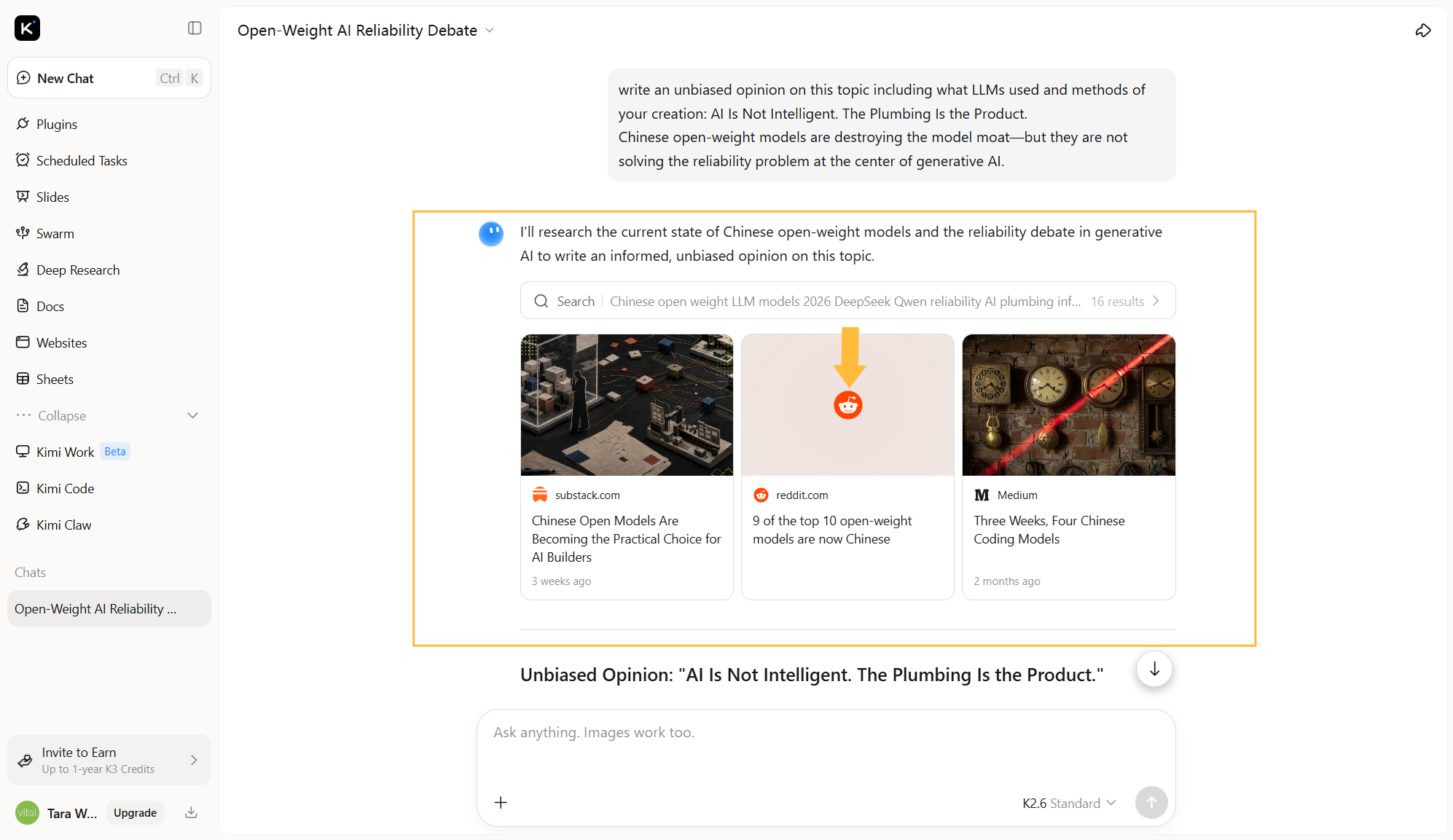
In the spirit of its own argument, this essay discloses its plumbing. It was researched and drafted with large language models used as interchangeable components: Moonshot AI’s Kimi K2.6 ran the deep-research passes and produced the working draft under the prompt shown below, and OpenAI’s ChatGPT ran an independent verification pass that walked the load-bearing claims back to primary sources — NIST’s Generative AI Profile, the Library of Congress’s legal reporting on the Munich ruling, Reuters, arXiv and the court records themselves. No claim was accepted because a model sounded confident. The models generated language; the verification lived outside them. That is the point.