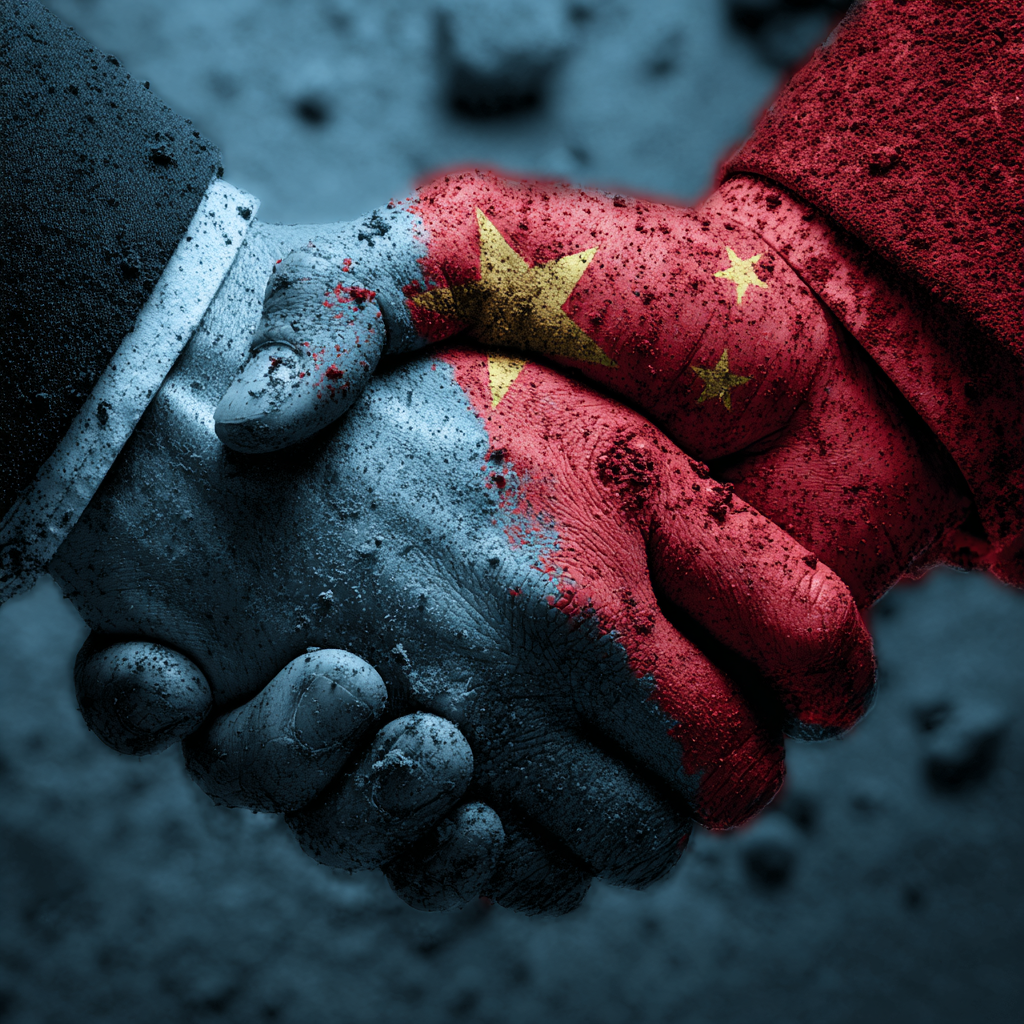
The U.S. built the rare-earths era, outsourced the mess, and now the global economy is paying the price.
Macro Supply Chain
Trade War Risk
AI & Energy
##### Key Takeaways Summary
- The U.S. once dominated rare earth elements (REEs) but ceded control to China by the early 2000s due to environmental costs and outsourcing.
- China now controls ~70% of mining, ~90% of refining, and ~93% of magnet manufacturing — critical leverage in a trade war.
- Roughly 15–20% of the U.S. economy—about $4–5 trillion—is tied to REE-dependent sectors like tech, defense, autos, AI, and energy.
- Any Chinese export restrictions could ripple through global markets, sparking inflation and policy intervention.
###### Mining
~70% Global Supply
###### Refining
~90% Processing
###### Magnets
~93% NdFeB Output
##### U.S. vs China vs Allies — Rare Earth Control
RegionMining ShareRefining CapacityMagnet ProductionPolicy Position
China
≈ 70%≈ 90%≈ 93%
Strategic dominance & export leverage
United States
≈ 14%< 10%< 1%
Rebuilding domestic refining & processing
Allied Nations (Australia, Japan, EU)
≈ 16%≈ 8%≈ 6%
Joint ventures & supply diversification
##### The New Dirt War
The U.S.–China trade war is no longer just about tariffs or semiconductors — it’s about control over the materials that power every advanced economy. Rare earths form the invisible foundation of modern technology, from EVs to AI chips. Whoever controls their flow can tilt global markets.
##### When the U.S. Mined the Future
In 1949, bastnäsite ore at Mountain Pass, CA, made America the rare-earth capital of the world. For nearly four decades, the U.S. supplied more than two-thirds of global demand. REEs powered TVs, missile guidance, lasers, and early computers.
By the 1980s, production topped 20k tons/year — but environmental fallout was steep. Wastewater with radioactive thorium leaked into desert basins. As regulations tightened, corporations outsourced the mess.
##### How China Built Its Rare Earth Empire
Throughout the 1980s–90s China subsidized extraction and refining, ignoring environmental damage. Deng Xiaoping’s 1992 line — “The Middle East has oil; China has rare earths” — became policy.
By 2000, China controlled 97% of global supply. When it restricted exports to Japan in 2010, prices spiked 1,000%. The world was reminded the digital economy is still built on dirt.
Reality check: Offshoring didn’t end “dirty” mining — it exported it.
##### The Human Cost of the Clean Tech Era
In Baotou and Bayan Obo (Inner Mongolia) entire villages were poisoned by refinery runoff. Tailings ponds blackened air and water, cancer rates rose, and the West got cheap EVs and phones built on toxic supply chains.
##### How Much of the U.S. Economy Depends on REEs?
REEs total only a few thousand tons but underpin ≈15–20% of U.S. GDP ($4–5 trillion). Defense, aerospace, AI infrastructure, and energy rely on REE-based magnets and materials. Most ore still ships to China for processing.
Most valuable element: Neodymium (Nd) — key to EV motors, turbines, phones, and AI servers — worth up to $150k/ton and irreplaceable in next-gen systems.
##### Investor Takeaways Playbook
- Policy watch: New export controls or quotas → instant REE price reaction; margin compression in hardware/EV sectors.
- Capex flows: Monitor DoD/DOE grants, on-shoring announcements, and strategic-stockpile contracts.
- Rotation risk: Commodity & miner upside vs. short-term pressure on growth tech valuations.
- Macro spillover: Input inflation could firm yields and increase volatility across indices.
- Resilience premium: Firms with diversified supply chains or recycling tech gain long-term advantage.
##### When Geopolitics Meets the Stock Market
- Supply Shock: Export restrictions could ignite REE prices overnight, squeezing margins for Apple, Nvidia, Tesla, and defense contractors.
- Inflation Wave: Shortages raise manufacturing costs and consumer prices, forcing central banks to balance inflation vs security investment.
- Sector Rotation: Domestic miners and refiners could soar while growth tech lags.
- Policy Surge: Pentagon and DOE funding for refineries and stockpiles mirrors 1970s oil reserve strategy.
##### Global Market Disruption: The Aftermath
A prolonged rare-earth trade war would ripple through every index. European and Asian manufacturers are just as exposed. Shortages could lift bond yields and pressure risk assets.
FX markets react first: the yuan strengthens, the dollar and euro wobble. Export manufacturing EMs feel the shock next. Electrification metals (copper, lithium, cobalt) surge with volatility.
The bigger picture — a global rethink of resource dependence and industrial alliances in the AI era.
##### Sources & Further Reading
- USGS – Rare Earth Elements Overview
- Reuters – U.S. rare-earth chokepoint & China export control
- Yale E360 – Toxic aftermath of rare-earth mining
- The Guardian – Pollution in Baotou
- CSIS – Developing processing hubs
Disclosure: Informational only — not investment advice. Do your own research before trading or investing.