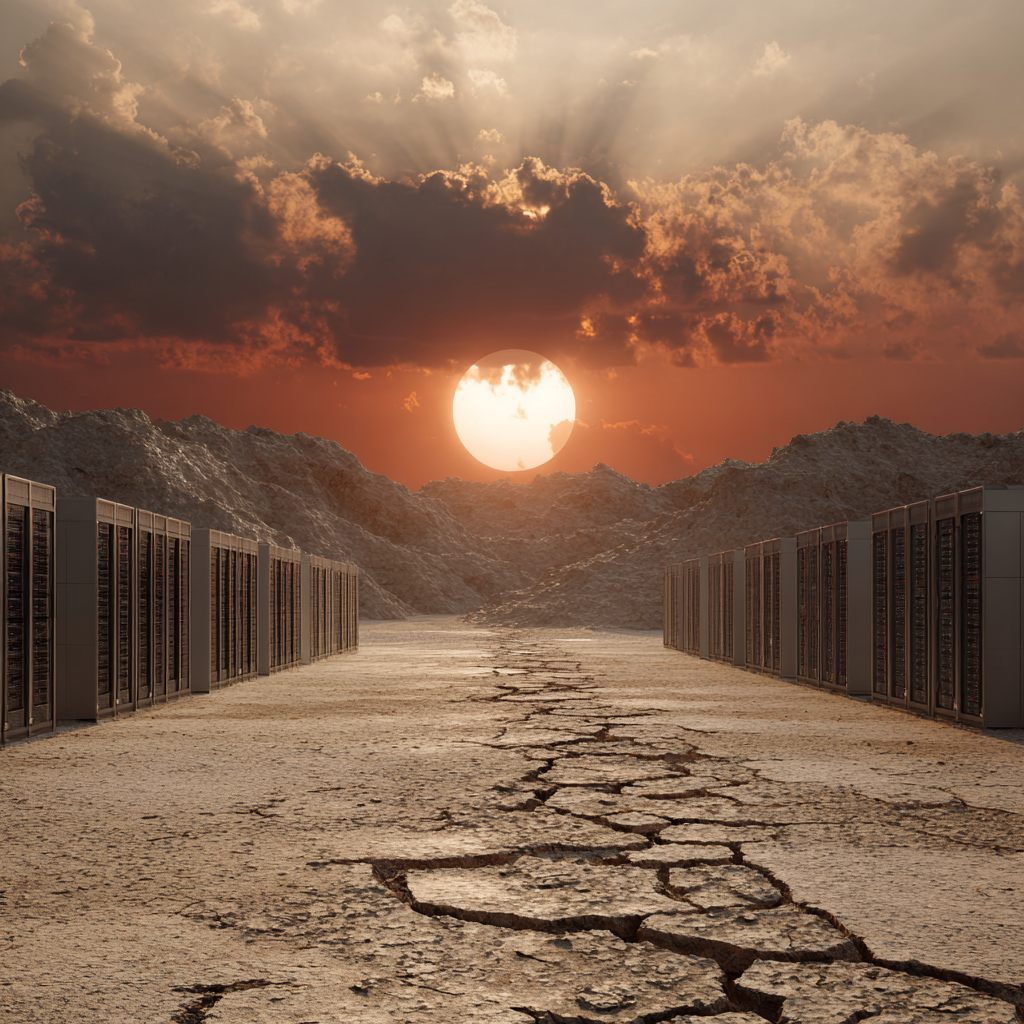
Inside the race for GPU performance and the hidden cost of keeping AI cool.
AI Infrastructure
Energy Economics
Sustainability
##### Key Takeaways Summary
- NVIDIA’s Blackwell architecture narrows training time gaps but pushes total data center power draw higher.
- AI data centers may consume up to 1,000 TWh annually by 2026, rising to 50 percent of global data center demand by 2030.
- Energy efficiency per chip improves, but total system demand grows faster due to cluster scale, cooling, and redundancy.
- Lifecycle emissions now include embedded GPU manufacturing and cooling infrastructure, not just operational wattage.
- Regulators in the EU and US are moving toward full-scope environmental disclosures for hyperscale sites.
##### Thesis → The Power Cost of Intelligence
Each new GPU generation delivers more compute per watt but accelerates total power demand. Data centers are no longer limited by transistor speed. They are limited by air, water, and heat extraction. As AI workloads scale, the sustainability curve bends upward instead of down.
Faster chips no longer mean greener systems. Performance density has outpaced power and cooling efficiency.
Excerpt — Generative AI Impact Assessment (PIIS2666998625001474)
##### Evidence → Blackwell vs Hopper: What the Data Shows
In Dissecting the NVIDIA Blackwell Architecture with Microbenchmarks (arXiv 2507.10789v2), researchers measured core metrics comparing Blackwell GB203 to Hopper GH100.

Figure 10. Global memory bandwidth comparison: Hopper 15.8 TB/s vs Blackwell 8.2 TB/s.

Figure 11. Runtime per matrix size (M×N×K) — Hopper remains faster and more stable in FP8 workloads.

Figure 12. Power consumption scaling by workload — Hopper demonstrates better energy proportionality.
Interpretation: Incremental GPU efficiency gains are overshadowed by the exponential scale of cluster deployments. Each new node saves watts per compute unit but adds megawatts overall.
##### Findings → The Lifecycle Burden of AI Infrastructure
According to Generative AI Impact Assessment through a Life Cycle Analysis of Multiple Data Center Typologies (SSRN 5234773), AI-related workloads will soon represent half of all data center energy use. The paper segments centers by capacity and emissions profile.

Figure 1. Data center segmentation — edge, colocation, and hyperscale (>10 MW) sites dominate AI workloads.

Table 2. Environmental impacts by data center type (GWP, water use, and waste per MW-year).
Training a large AI model can generate up to 6,700 tons of CO₂ — more than a decade of emissions from 500 American households.
Life-Cycle Assessment of AI Data Centers (SSRN 5234773)

Table 4. Cross-country GWP comparison — U.S. vs Canada vs China. Canada’s hydro power mix halves emissions intensity.
##### Regulatory Pressure → Energy Transparency
Europe’s Energy Efficiency Directive 2023/1791 requires all facilities above 500 kW to report power usage effectiveness (PUE), water consumption, and renewable share starting 2024. The U.S. Department of Energy is moving toward similar reporting standards for AI clusters.
The next competitive frontier is transparency. Investors and governments want to know how much energy intelligence really costs.
Performance, Efficiency, and Cost (PIIS2666998625001474)
##### Investor Takeaways Playbook
- Capex reality: AI infrastructure spending remains bullish, but long-term margins depend on energy efficiency per model trained.
- Policy watch: ESG mandates and carbon disclosures could shift market advantage to firms building in hydro or nuclear grids.
- Thermal choke risk: Data center growth may stall in regions with limited cooling water or grid expansion capacity.
- Hardware outlook: Expect future GPUs to integrate liquid cooling or AI power-management co-processors as a design default.
##### Bottom Line
The AI revolution runs on electricity. Each generation of chips pushes computing forward but also stretches the limits of heat, water, and carbon capacity. NVIDIA’s hardware edge remains strong, yet the long-term moat will depend on how efficiently intelligence can stay cool.
##### Sources & Further Reading
- Dissecting the NVIDIA Blackwell Architecture with Microbenchmarks (arXiv 2507.10789v2)
- Generative AI Impact Assessment: Performance, Efficiency, and Cost (PIIS2666998625001474)
- Life-Cycle Assessment of AI Data Centers (SSRN 5234773)
Informational only. Not investment advice.