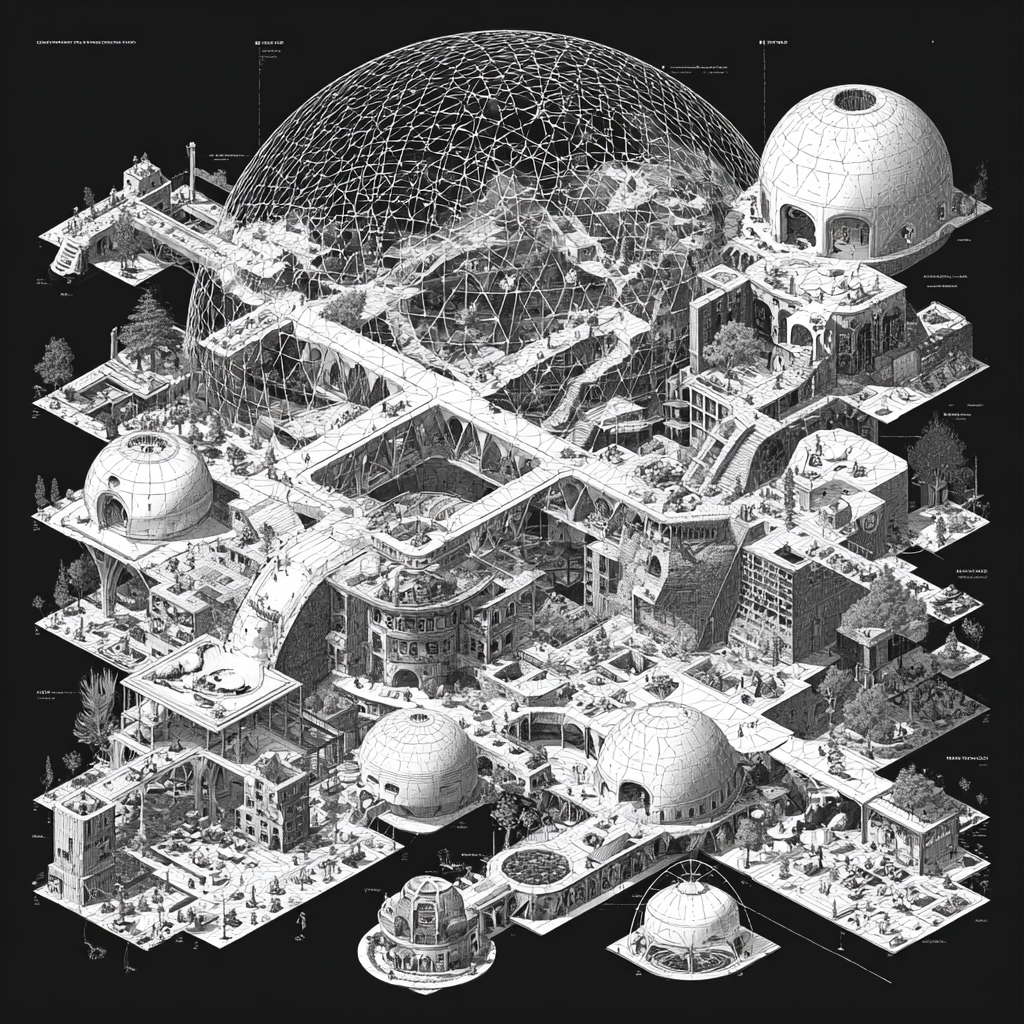
Modern hedge funds no longer resemble the star-manager funds of the past. Today’s markets are dominated by modular “Pod Shops”—industrial-scale alpha factories where human traders are the raw material and forced liquidation is the byproduct.
##### Investigative Summary MARCH 2026
- The Pod Architecture: Multi-manager funds divide capital into dozens or hundreds of small “pods” competing against each other for survival.
- The Hard Stop Regime: Many pods face 5% drawdown risk cuts and 7–10% termination thresholds, creating mechanical liquidation cascades.
- The Crowded Hive Effect: When similar quant models converge on the same trade, forced exits can trigger violent market moves.
The Meat Grinder: Inside the Pod Shop
Walk through the glass towers of Hudson Yards or Mayfair and the modern hedge fund industry appears calm and surgical.
But beneath that surface operates one of the most competitive financial structures ever created.
Firms like Citadel, Millennium, Point72, and Balyasny no longer run centralized portfolios. Instead they operate as modular alpha factories, dividing capital across dozens or even hundreds of small autonomous trading teams.
Each of these teams is known as a Pod.
A typical pod contains:
Role
Function
Portfolio Manager
Responsible for strategy and P&L survival
Quant Researchers
Build factor models and statistical signals
Analysts
Sector expertise and thesis development
Execution Trader
Market microstructure and order routing
Each pod typically receives $100M–$200M in capital before leverage.
Their mandate is brutally simple:
Generate uncorrelated returns—or be replaced.
“The modern hedge fund isn’t a team sport. It’s a Darwinian lab experiment where the inputs are traders and the output is alpha.”
— Former Multi-Manager Portfolio Manager
The Hard Stop Regime
Traditional hedge funds once allowed portfolio managers to endure large drawdowns while waiting for a thesis to play out.
Pod shops removed that luxury.
Instead they enforce strict risk triggers designed to eliminate losing strategies quickly.
Two mechanisms dominate:
- The Half-Life Cut: A roughly 5% loss can trigger a capital reduction, often cutting a pod’s allocation in half.
- The Terminal Stop: Drawdowns approaching 7–10% may result in the pod being shut down entirely.
Entire teams can be removed from the system within hours.
Industry estimates suggest that 15–20% of portfolio managers are replaced each year inside these structures.
The alpha factory must constantly recycle talent.
The Crowded Hive
The pod structure introduces a unique systemic risk.
Because many pods rely on:
- similar data feeds
- similar factor models
- similar catalysts
- similar macro frameworks
they frequently converge on the same trades.
This creates what traders call a crowded position.
When a narrative breaks, the exit can become chaotic.
The first pod to hit its risk threshold begins selling.
That selling pressure pushes the price further against other pods holding the same position.
Soon their risk systems trigger as well.
The result can become a cascade of forced liquidations.
“In crowded trades you’re not trading fundamentals anymore. You’re trading the probability that someone else has to liquidate.”
— Institutional Equity Strategist
Momentum Over Value
One of the defining characteristics of pod-driven markets is their emphasis on short-term catalysts and momentum rather than long-term valuation.
Portfolio managers are often judged on monthly performance.
Many internal risk systems discourage holding positions for extended periods.
This creates an environment of high-velocity capital turnover where price movements can temporarily disconnect from fundamental value.
For traders studying market behavior, these dynamics often appear as sudden price spikes, collapses, or reversals driven less by fundamentals and more by positioning and risk management mechanics.
Market Dynamic
Behavior Inside Pod Shops
Market Impact
Crowded Positions
Multiple pods hold identical trades
Amplified volatility during exits
Hard Stop Risk Limits
Strict drawdown triggers
Forced liquidation cascades
Short Holding Periods
Performance measured monthly
Momentum often outweighs valuation
The Stock Psycho Perspective
Modern markets are not simply battles between retail investors and institutions.
Much of the competition happens within the institutional ecosystem itself.
Pods are effectively racing to:
- identify the same narrative earlier than competitors
- enter positions first
- exit before the crowd
When everyone sees the same opportunity, the real risk becomes who is forced to sell first.
##### Final Research Findings
- Pod Shops Reshaped Markets: The modular hedge fund structure has created internal competition that can amplify market volatility.
- Risk Systems Drive Behavior: Hard stop drawdown limits can accelerate exits and crowd reactions.
- Positioning Matters: In many cases, price movements reflect the mechanics of institutional positioning rather than underlying fundamentals.
In modern markets, the biggest moves often begin not with new information—but with someone hitting their risk limit.
##### Takeaway
When you see a stock drop 8% in two hours on no news, it’s probably not fundamentals.
It’s a pod hitting their ~5% drawdown limit and triggering a liquidation cascade.
The move often reverses within 3–7 days.